

As the European EPS industry continues to strengthen circularity, collaboration between manufacturers and recyclers is becoming increasingly important. A practical example can be found in the partnership between HIRSCH France and BEWI Circular, which has established an efficient system for collecting, recycling and reintroducing expanded polystyrene (EPS) into new production. By connecting customers, manufacturers and recyclers within the same value chain, the initiative demonstrates how cooperation can help increase recycling rates, reduce waste and support the transition towards a more resource-efficient and circular economy.
A partnership built on shared objectives
The collaboration began around two years ago, when BEWI Circular presented its recycling activities and ambitions to HIRSCH France. At the same time, HIRSCH France was developing its REuse recycling service, recognising the increasing importance of resource-efficient material management for the EPS industry.
Following discussions and a visit to HIRSCH France's production site in Vienne, both companies agreed to work together to establish an effective recycling loop for post-industrial and construction EPS.
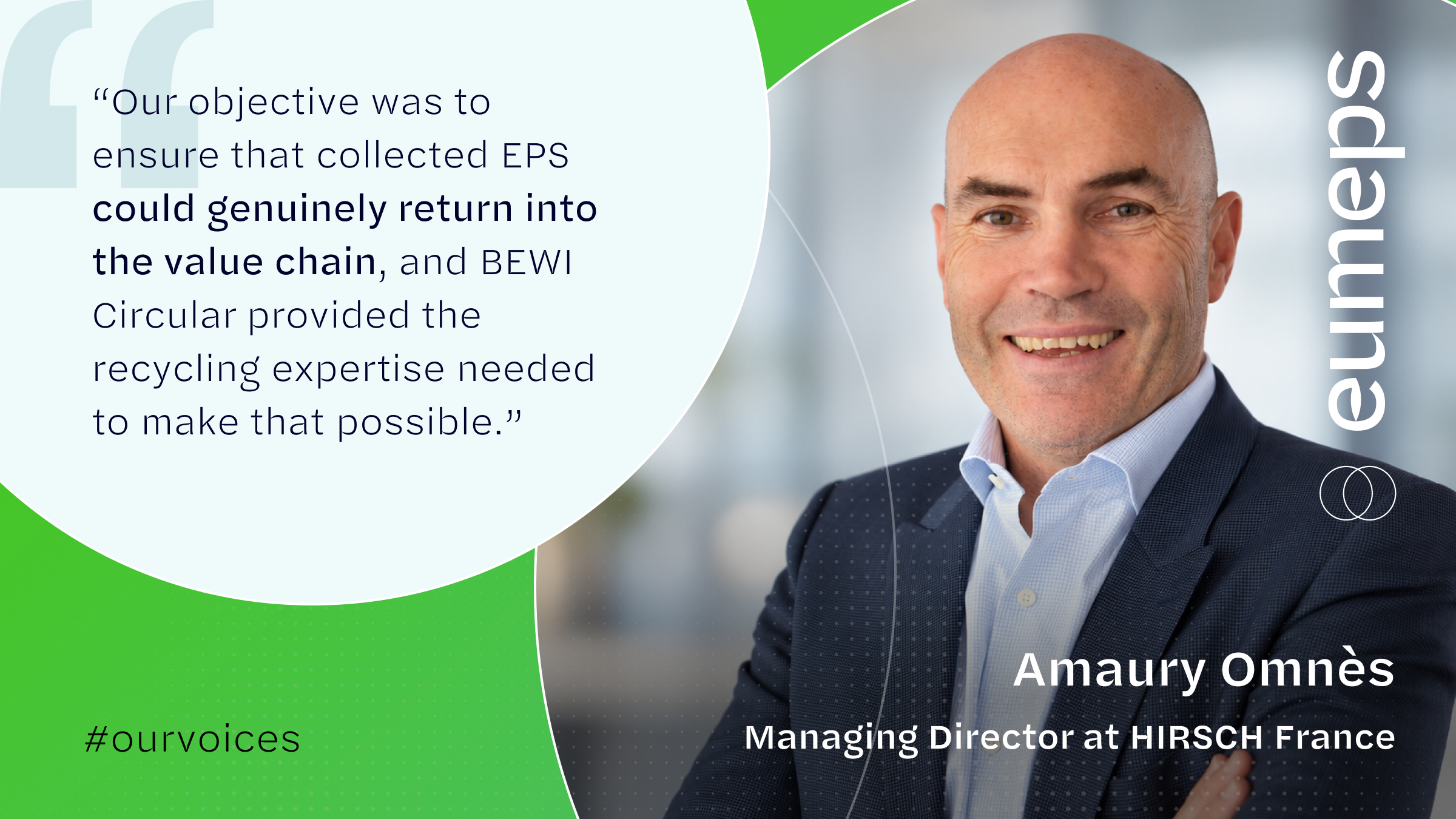
Reflecting on the start of the cooperation, Amaury Omnès, Managing Director of HIRSCH France explains:
"We quickly realised that our ambitions were perfectly aligned. Our objective was to ensure that collected EPS could genuinely return into the value chain, and BEWI Circular provided the recycling expertise needed to make that possible."
Closing the loop for EPS
The cooperation focuses on recovering clean EPS offcuts generated by customers during manufacturing and construction activities.
HIRSCH France supplies collection bags to customers, who fill them with EPS offcuts from cutting operations or construction sites. Once collected, the material is returned to HIRSCH France's recycling facility in Vienne, France.
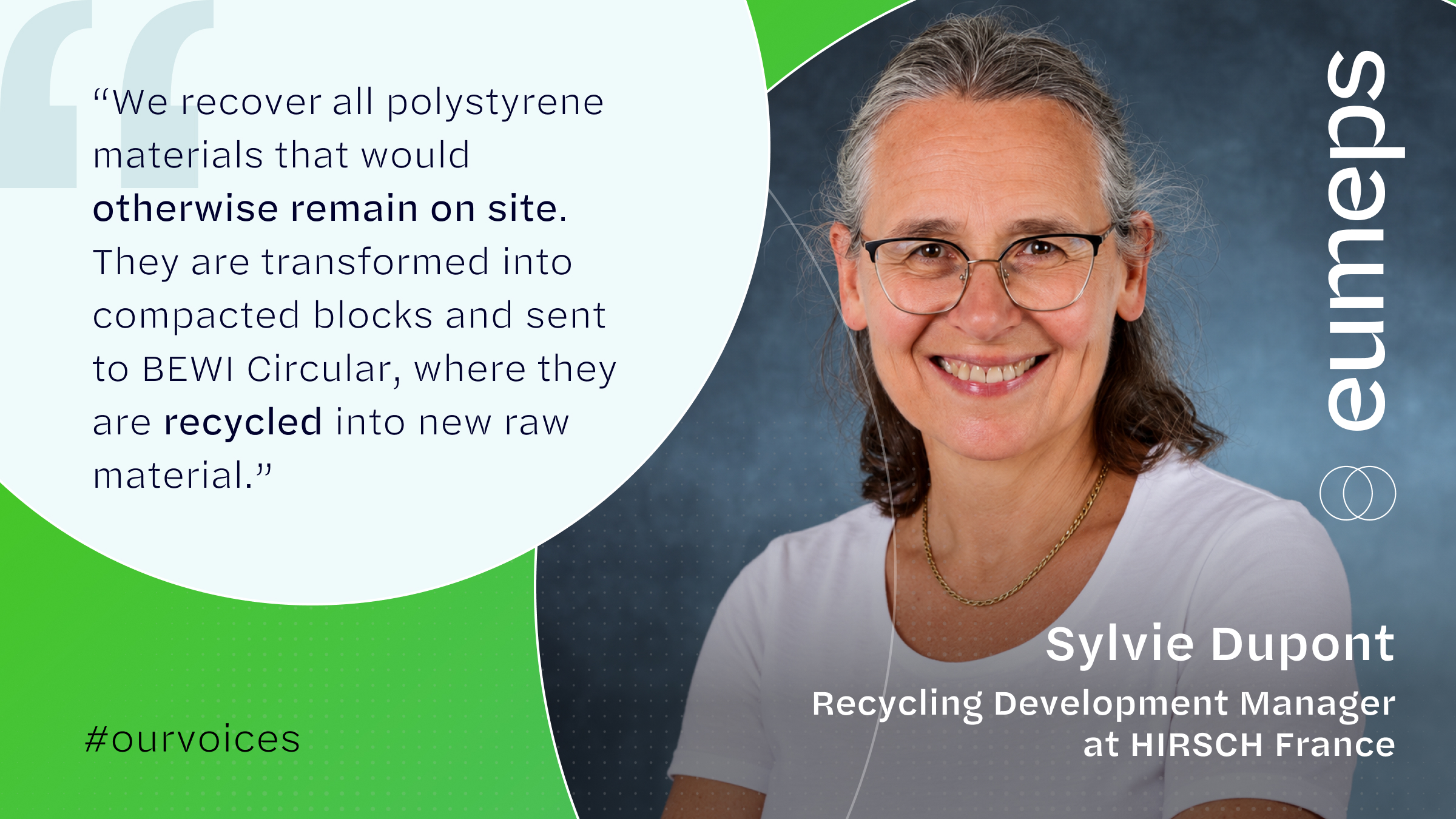
As Sylvie Dupont, Recycling Development Manager at HIRSCH France, explains:
"We recover all polystyrene materials that would otherwise remain on site. They are transformed into compacted blocks and sent to BEWI Circular, where they are recycled into new raw material. This recycled material can then be reintroduced into our future production."
Material that cannot be directly reused is compacted into high-density blocks before being transported to BEWI Circular. There, it is recycled into high-quality recycled polystyrene that can be incorporated into new EPS products, supporting a more climate-neutral and circular economy.
Turning challenges into practical solutions
Developing an efficient recycling system also requires overcoming several practical challenges. Construction waste can be contaminated by mortar or other materials, while white and grey EPS must be separated before recycling to maintain material quality.
Economic considerations are equally important. A successful circular model must create value for every participant in the chain, including customers, collectors, manufacturers and recyclers.
According to Amaury Omnès:
"For recycling to become a long-term solution, every stakeholder must see a benefit. The process needs to be technically reliable, economically viable and simple enough to be adopted on a larger scale."
Close cooperation between HIRSCH France and BEWI Circular has enabled both companies to define common specifications for collection, sorting and material preparation, creating a robust and efficient recycling process.
Delivering measurable results
The partnership is already producing tangible results. Around 20 to 30 tonnes of compacted EPS are currently sent each month from HIRSCH France's Vienne facility to BEWI Circular for recycling.
These volumes are expected to grow as compactors are progressively installed at additional HIRSCH production sites, allowing more material to be recovered and processed.
Beyond increasing recycling rates, the cooperation also provides customers with greater transparency. Through the REuse service, HIRSCH France can demonstrate exactly how collected EPS is recycled and transformed back into a valuable raw material.
The recycled material contributes to increasing recycled content in EPS products while supporting European objectives for resource efficiency, energy-saving construction solutions and reduced carbon emissions.
A model for the European EPS industry
The collaboration between HIRSCH France and BEWI Circular illustrates how partnerships across the value chain can transform circular economy ambitions into practical industrial solutions.
By combining efficient collection systems, high-performance recycling technologies and close technical cooperation, both companies have established a model that can be replicated across Europe. As collection networks continue to expand, collaborations of this kind will play an increasingly important role in ensuring that EPS remains a sustainable, innovative and valuable material for future generations.