
EPS Applications: Beyond Insulation and Packaging
Expanded Polystyrene (EPS) is used in a range of construction, civil engineering and technical applications beyond building insulation and protective packaging. Its low density, thermal properties, compressive resistance and ability to be manufactured in different shapes and dimensions allow it to fulfil different functions depending on the product, system and application.
Civil Engineering and Geofoam
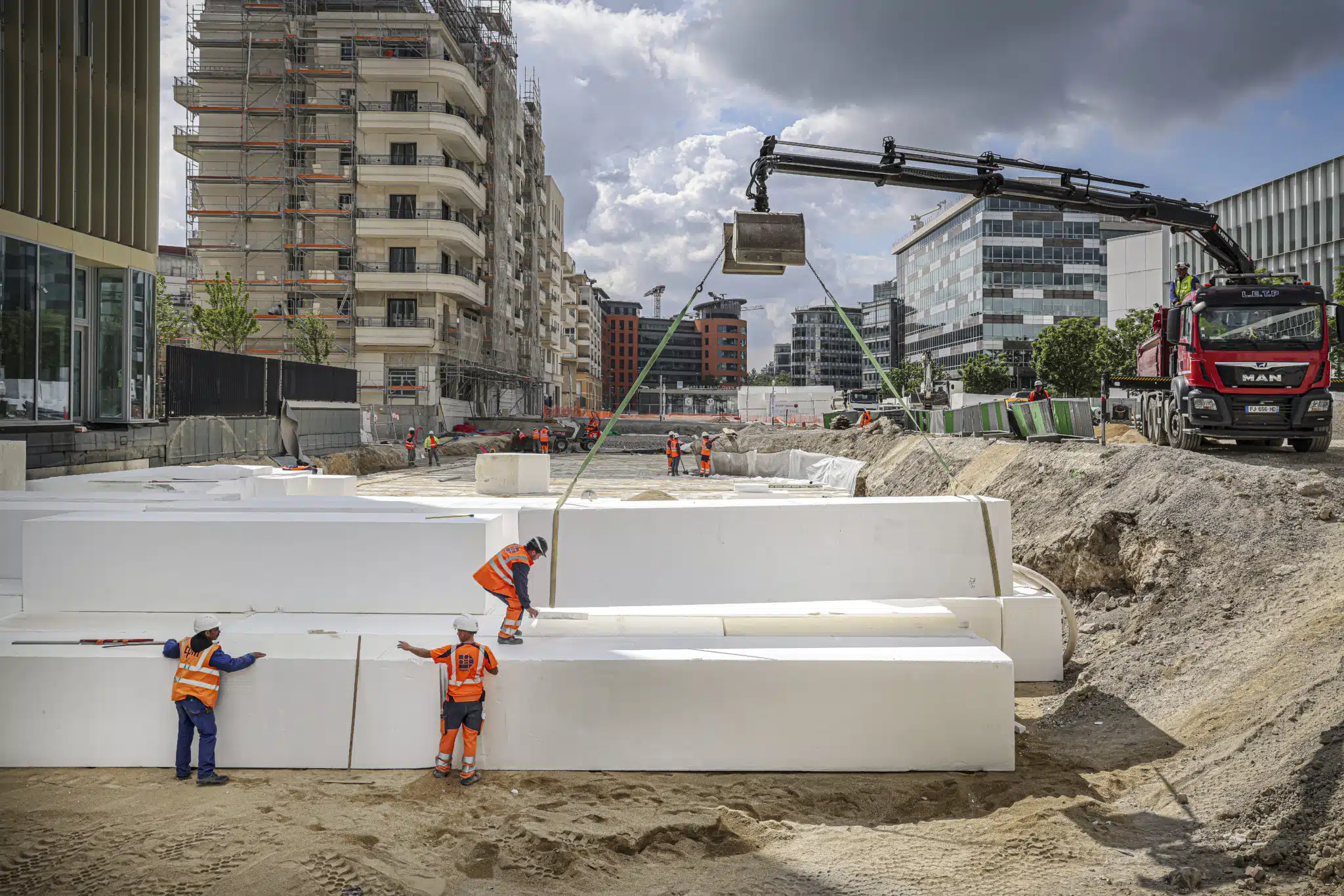 EPS blocks, commonly referred to as EPS geofoam, are used as lightweight fill in civil engineering projects.
Their low density can reduce the additional load placed on underlying soils and structures compared with conventional fill materials. This can be relevant in projects involving soft or compressible ground, existing infrastructure or areas where additional loading needs to be limited.
EPS geofoam can be used in applications such as:
- road construction and road widening;
- embankments;
- bridge approaches;
- railway infrastructure;
- slope stabilisation;
- retaining structures; and
- engineered landscaping.
The suitability of EPS for a particular project depends on the geotechnical and structural design, including factors such as loads, groundwater conditions, buoyancy, drainage and protection requirements.
(credit: HIRSCH Isolation)
Lightweight Concrete, Screeds and Mortars
EPS beads can be incorporated into cement-based products to produce lightweight concrete, screeds, mortars and filling materials.
In these applications, EPS can replace part of the conventional aggregate and reduce the density of the finished product.
Depending on the formulation and intended use, EPS-containing mixtures can be used for applications including:
- floor levelling;
- lightweight filling layers;
- screeds;
- non-structural concrete applications; and
- lightweight mortars and plasters.
The properties of the final product, including density, compressive strength and thermal performance, depend on the complete formulation and the proportion and characteristics of the EPS used.
Swimming Pool Construction
EPS is also used in swimming-pool construction, particularly in modular wall and formwork systems.
Interlocking EPS blocks can be assembled on site and combined with reinforcement and concrete as part of the complete pool structure. Their low weight can facilitate handling and installation.
EPS can also contribute to the thermal performance of the pool wall.
Actual heat losses and energy consumption depend on the complete pool system, including its design, dimensions, water temperature, pool cover, heating system, installation and operating conditions.
Road and Railway Infrastructure
EPS can be used beneath roads, railways and other transport infrastructure as a lightweight engineered material.
Where conventional fill would place significant additional loads on the underlying ground, EPS geofoam can be used to reduce these loads.
This can be relevant for construction over soft soils, road widening projects, bridge approaches or infrastructure built close to existing structures.
Its use is determined through project-specific geotechnical and structural design.
Void Formers and Shaped Construction Components
EPS can be moulded or cut into a wide range of shapes, allowing it to be used as a void-forming material or as part of prefabricated construction systems.
These components can be used to create specific geometries while limiting additional weight.
Applications can include:
- void formers;
- permanent formwork;
- architectural shapes;
- prefabricated construction elements; and
- shaped components incorporated into larger building systems.
The technical role and required properties of EPS vary according to the application and the system in which it is used.
Protective and Safety Applications
EPS is also used in products designed to help protect people during impacts.
Its cellular structure can absorb and dissipate part of the energy generated during an impact, which is why EPS is used as a protective component in a range of safety products.
Applications include:
- bicycle and cycling helmets;
- motorcycle and other protective helmets;
- child car seats;
- protective sports equipment; and
- other impact-protection systems.
In these products, EPS generally forms part of a complete safety system rather than acting as a standalone protective element. The level of protection depends on the design of the product, the EPS grade and geometry, the other materials used and compliance with the applicable safety requirements and testing standards.
The role of EPS can therefore differ significantly between applications, but in each case its performance must be assessed as part of the complete product.
Technical and Specialised Applications
The ability to manufacture EPS in different densities, dimensions and shapes also allows it to be used in a range of specialised technical applications.
Depending on the required function, EPS can provide lightweight filling, thermal insulation, impact absorption, dimensional shaping or a combination of these properties.
The appropriate EPS product and performance requirements depend on the intended use, applicable standards and the design of the complete system.
One Material, Different Functions
These applications illustrate the range of functions EPS can perform outside its most widely recognised uses in building insulation and packaging.
Its role varies according to the application: from lightweight fill in civil engineering to components in cement-based products, swimming-pool systems and shaped construction elements.
Performance therefore needs to be assessed according to the relevant product specification, intended use and complete system design.