
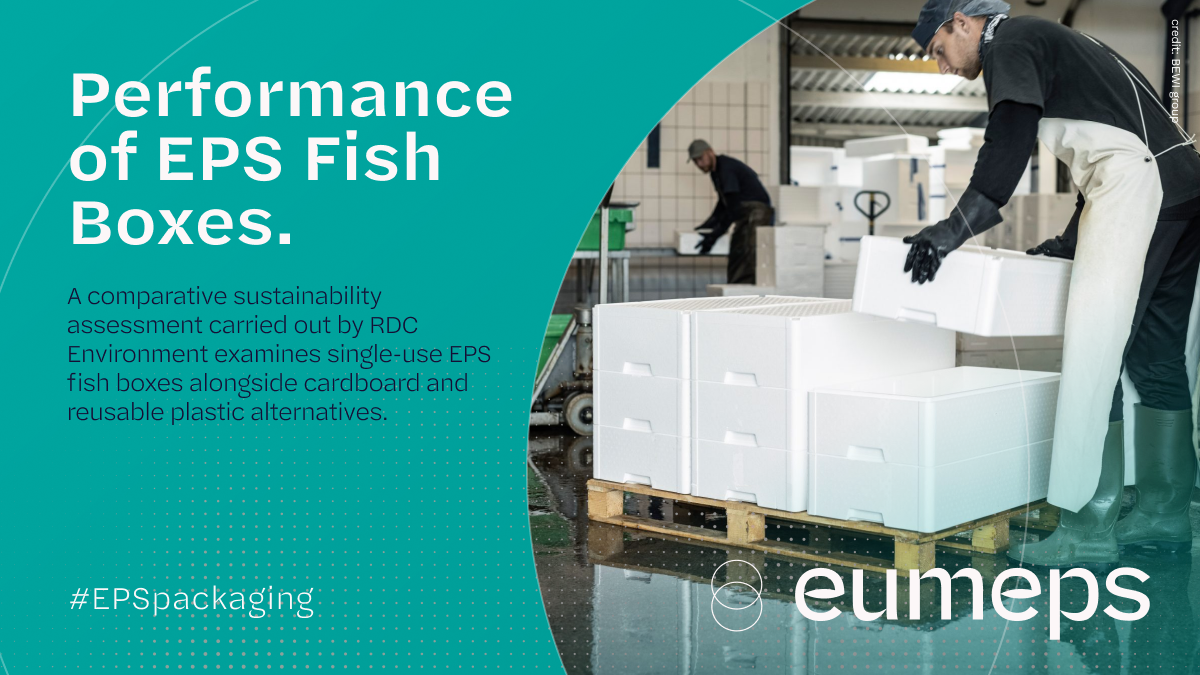
A comparative sustainability assessment carried out by RDC Environment examines single-use EPS fish boxes alongside cardboard and reusable plastic alternatives. Under the scenarios assessed, the study finds that EPS performs favourably on aggregated environmental, economic and social impacts for transport distances above 200 km, while the results vary by impact category and distribution distance.
The study, commissioned by EUMEPS, assesses the transport and protection of fresh fish across the European cold chain and considers the full life cycle of the packaging systems studied.
Comparing fish-box systems across their life cycle
Fish boxes play a central role in maintaining temperature, food quality and hygiene during the transport of fresh fish.
The RDC Environment study, Comparative Sustainability Assessment of Fish Boxes in Europe, compares five packaging systems:
- single-use EPS boxes;
- reusable EPS boxes;
- single-use cardboard boxes;
- insulated reusable polypropylene (PP) boxes; and
- non-insulated reusable high-density polyethylene (HDPE) boxes.
The assessment covers the full life cycle of the packaging systems, including raw-material production, manufacture, transport of empty packaging, ice production, distribution of fish, cleaning and return logistics where applicable, and end-of-life treatment.
The functional unit used in the study is the transport and protection of fresh fish in direct contact with ice during one stage of distribution in the European Union, resulting in 1 kg of fish fit for human consumption at the point of sale. The environmental LCA component was reviewed against ISO 14040 and ISO 14044 by an external expert panel.
What the study finds on environmental and socioeconomic impacts
According to RDC Environment, when environmental impacts are monetised and combined with economic costs and the social value of job creation, single-use EPS boxes show lower aggregated impacts than the alternative systems assessed once distribution distances exceed 200 km in the modelled scenarios.
For distances below 200 km, the study concludes that the differences between the five packaging systems are not significant when uncertainty and variations in real operating conditions are taken into account.
For the study’s base case, corresponding to a 2,800 km distribution distance, the researchers report that single-use EPS boxes have a lower aggregated impact per unit of fish delivered than the competing systems modelled.
AIPE, EUMEPS’ Italian member association, highlighted these findings following the publication of the assessment.
Giuseppe Rinaldi, President of AIPE, said:
“The research highlights an important point: the sustainability of a product must be assessed throughout its entire life cycle and in its real-use context.”
He noted in particular the importance of thermal performance and transport logistics when comparing packaging used for fresh fish.
Climate impact depends on transport distance
The study also shows why environmental comparisons between packaging systems need to take distribution distance into account.
For the climate-change impact category specifically, RDC Environment finds that alternative packaging systems do not provide an environmental benefit over single-use EPS once the distribution distance exceeds 1,250 km.
At shorter distances, the picture is more nuanced. The study finds that cardboard can have a lower climate-change impact than single-use EPS at shorter transport distances under certain modelling assumptions, mainly because production-related impacts are lower. As distances increase, however, transport-related factors become more significant. eps.co.uk
The study therefore does not identify one packaging material as having the lowest climate impact in every situation. Its results depend on transport distance, insulation requirements, ice use, return logistics and the specific packaging system being compared.
Thermal performance and fresh-fish transport
Thermal insulation is an important factor in the study because fresh fish must remain within controlled temperature conditions throughout distribution.
EPS has a thermal conductivity of approximately 0.037 W/(m·K) in the configuration considered in the assessment. The study models differences in the quantity of ice required by different box systems according to their insulating performance and transport distance.
This affects both the quantity of fish that can be carried in each box and the overall transport requirement. In the study’s 2,800 km base case, for example, more lorries are required for the cardboard system than for the EPS systems to transport the same quantity of fish, because the cardboard configuration modelled requires more ice and therefore leaves less available payload for fish.
These results relate to the packaging configurations and assumptions assessed in the RDC Environment study and should not be interpreted as applying identically to every fish-distribution system.
Food hygiene and reusable packaging
AIPE also points to hygiene management as an important consideration when comparing single-use and reusable fish-box systems.
Paolo Garbagna, Vice-President for Packaging at AIPE, said that reusable systems require appropriate washing, sanitisation and microbiological controls to manage potential hygiene risks.
These operational requirements are included within the broader life-cycle assessment of reusable systems, alongside return transport, cleaning and storage.
AIPE argues that collection and recycling systems should therefore remain part of the policy discussion alongside reuse. In Italy, its members participate in the PEPS network for the collection and recycling of EPS packaging.
Long-distance distribution
Transport distance is one of the factors with the greatest influence on the comparative results.
According to the study:
- below approximately 200 km, the aggregated impacts of the systems assessed do not differ significantly;
- above 200 km, single-use EPS performs better in the study’s aggregated environmental, economic and social assessment;
- above 1,250 km, none of the alternative systems assessed shows a climate-change benefit over single-use EPS under the study assumptions.
These findings are particularly relevant in the context of intra-European fresh-fish distribution, where transport distances can be substantial.
A life-cycle approach to packaging policy
The study was carried out in the context of the EU Packaging and Packaging Waste Regulation and its provisions on reusable transport packaging.
For EUMEPS, the results support the importance of assessing packaging systems on the basis of their full life cycle and actual conditions of use, rather than evaluating materials in isolation.
The assessment also shows that results can differ considerably depending on the environmental indicator considered. For example, the report identifies situations where alternative packaging performs better than single-use EPS for individual environmental indicators, while EPS performs better in the aggregated assessment under particular transport scenarios. eps.co.uk
This distinction is important when communicating comparative environmental performance and when assessing different packaging options for specific supply chains.
About the study
Comparative Sustainability Assessment of Fish Boxes in Europe was carried out by RDC Environment for EUMEPS.
The assessment combines:
- environmental life-cycle assessment;
- economic cost assessment; and
- assessment of the social value associated with job creation.
The environmental LCA evaluates impact categories recommended under the European Commission’s Product Environmental Footprint methodology and was externally reviewed against ISO 14040 and ISO 14044.