

How do manufacturing, education and community engagement shape one another? For Oya Sertdemir Düşmez, President of EPSDER, these responsibilities are closely connected. Her career reflects a belief that industrial development depends as much on people, skills and cooperation as it does on investment and technology.
Alongside her leadership of Türkiye’s EPS industry association, Oya works across manufacturing, education and civil society. Her responsibilities at Redcolour and Bilgem Schools, her involvement in the Elazığ Organised Industrial Zone and her voluntary work with the Turkish Education Foundation give her a perspective that connects national industry priorities with local opportunities.
In this edition of Faces of EUMEPS, she discusses the prospects for Türkiye’s EPS sector, the value of cooperation across borders and her commitment to helping the next generation find its place in industry.
Your career brings together manufacturing, education and civil society. How did this combination develop, and what connects these different parts of your work?
Throughout my career, I have been guided by a common purpose: creating lasting value and contributing to society’s long-term development.
As a second-generation leader at Bilgem Schools, I have had the opportunity to contribute to the education of future generations. At the same time, through Redcolour, I have pursued my entrepreneurial journey in the paints, insulation and chemicals industries.
Education has taught me the importance of human potential. Manufacturing has shown me what production and innovation can achieve, while civil society has demonstrated the value of collective action. My presidency of EPSDER, my involvement in the Organised Industrial Zone and my role as a representative of the Turkish Education Foundation all reflect this broader commitment.
What connects these areas is my belief that a country’s long-term prosperity depends on a strong industrial base, well-educated and skilled people, and effective cooperation between institutions.
What does EPSDER do, and what are your main priorities as its President?
EPSDER represents Türkiye’s expanded polystyrene industry and works to support its technical, economic and environmental development. Our mission is to strengthen the role of EPS in energy efficiency, sustainable construction, the circular economy and engineering applications.
As President, my main priorities are to:
- Expand the use of EPS in Türkiye.
- Encourage closer alignment between Turkish technical regulations, European standards and scientific developments.
- Promote better insulation performance and appropriate insulation thicknesses in buildings.
- Advance EPS recycling and circular economy practices.
- Strengthen cooperation between public authorities, academic institutions and industry.
- Improve the international visibility and competitiveness of Türkiye’s EPS sector.
One of our ambitions is to organise an international EPS Summit in Türkiye in collaboration with EUMEPS. I see it as an opportunity for technical dialogue, knowledge exchange and discussion of shared industry priorities, bringing European and Turkish colleagues closer together.
Ultimately, I want EPSDER to be an active, internationally connected organisation that contributes to the future of our industry.
What are the main opportunities and challenges facing Türkiye’s EPS industry today?
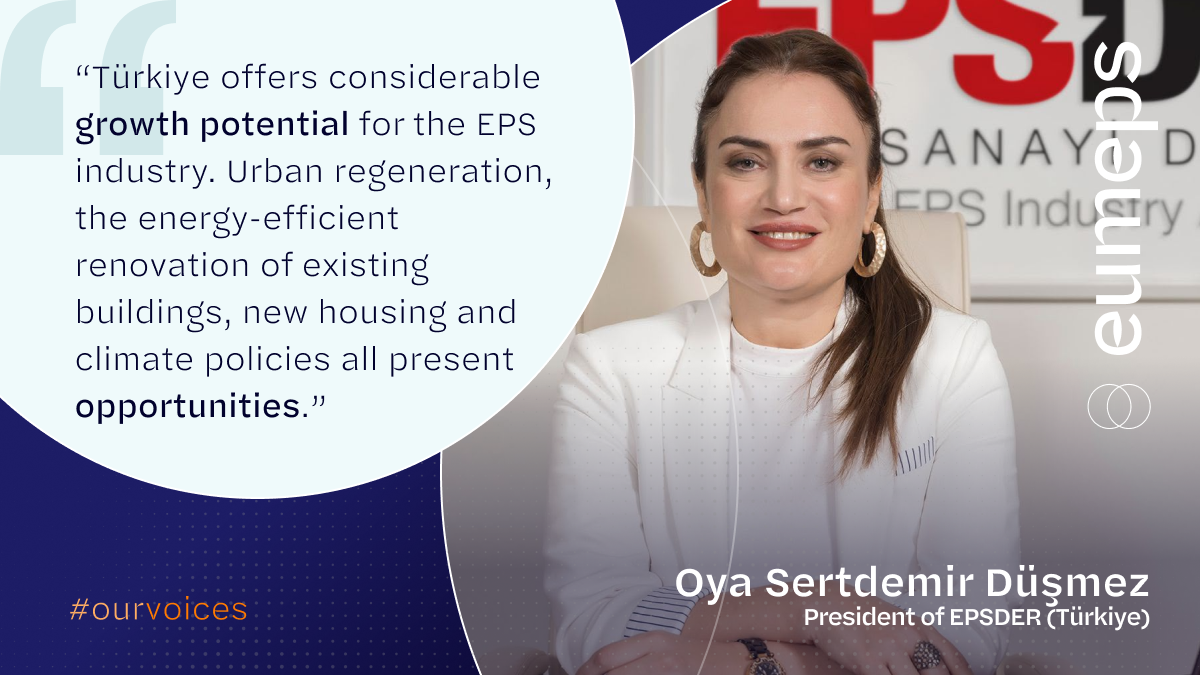
Türkiye offers considerable growth potential for the EPS industry. Urban regeneration, the energy-efficient renovation of existing buildings, new housing and climate policies all present opportunities.
Given Türkiye’s dependence on imported energy, improving the energy performance of buildings is an economic and strategic priority as well as an environmental responsibility. There is substantial scope to improve insulation standards and encourage thicknesses that deliver greater long-term energy savings.
At the same time, our industry faces regulatory constraints, high financing costs, raw material price volatility and misconceptions about EPS.
Fire safety is an area where I believe a scientific approach that considers the complete construction system is particularly important. Assessments should take account of system performance, installation quality and relevant testing evidence, alongside the characteristics of individual materials.
Our responsibility as an industry is to explain the performance, economic benefits and environmental contribution of EPS through credible scientific evidence. With its manufacturing capabilities, entrepreneurial experience and geographical position, Türkiye has the potential to play a greater role in the international EPS industry.
You have highlighted geofoam as an application you would like to develop further. What interests you about it, and what would help its wider adoption?
Geofoam illustrates how EPS can serve engineering applications beyond conventional thermal insulation.
Its low weight, compressive strength and ease of installation make it useful in road construction, bridge approach embankments and infrastructure projects, including those involving challenging ground conditions.
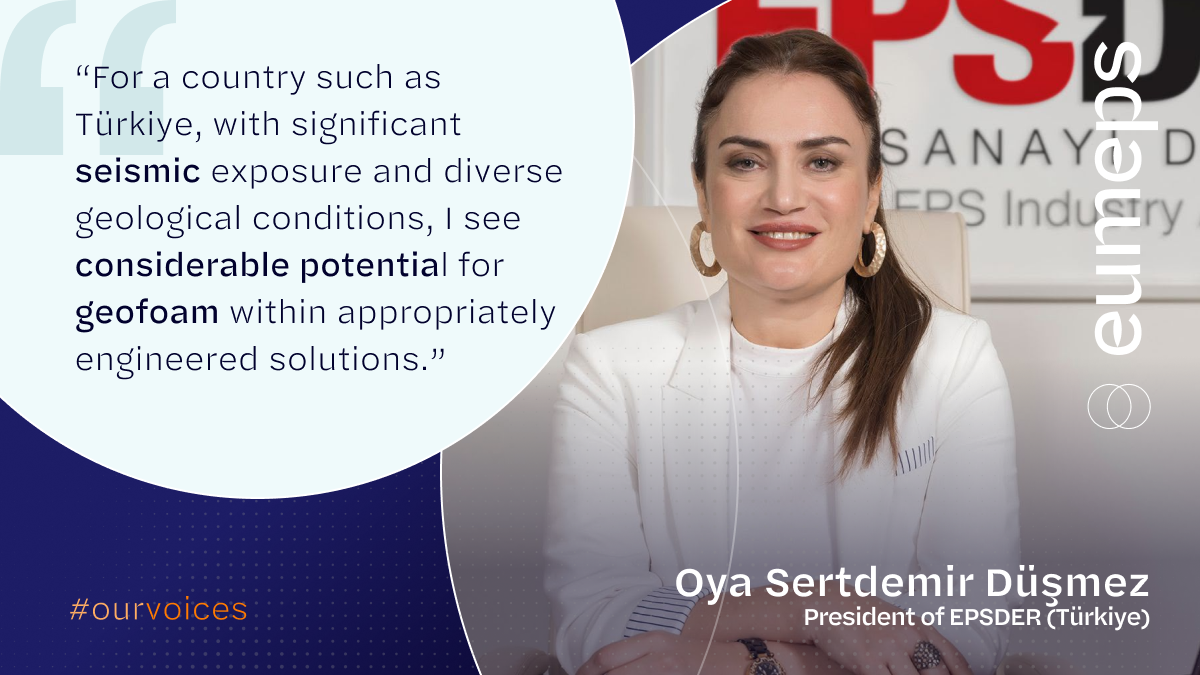
For a country such as Türkiye, with significant seismic exposure and diverse geological conditions, I see considerable potential for geofoam within appropriately engineered solutions. However, this potential remains relatively underexplored in our domestic market.
Wider adoption will require greater awareness among public authorities, civil engineers and project developers. Technical specifications, demonstration projects and successful international case studies will also be important.
I am particularly interested in drawing on European expertise through the EUMEPS network. We should increasingly explain the role of EPS as a versatile engineering material, alongside its established use in insulation.
Your work in Elazığ gives you a close connection to regional industry. What have you learned about the relationship between manufacturing, employment and regional development?
Being an industrial entrepreneur in Anatolia has shown me that manufacturing’s contribution extends beyond economic growth.
When you establish a factory, you also contribute to the future of the surrounding community. You create employment, strengthen local supply chains, develop skills and give young people opportunities to build their careers close to home.
My experience in Elazığ has reinforced my belief in manufacturing’s role in regional development. However, lasting progress requires more than industrial investment. It also depends on quality education, vocational training, efficient logistics and access to finance.
Increasing the participation of women and young people in industrial employment is another essential part of this work.
Türkiye’s economic potential is not concentrated solely in its major cities. Anatolia has considerable entrepreneurial talent and industrial capabilities. With appropriate policies, investment and international connections, regional cities can become competitive manufacturing centres.
How does your experience in education influence your approach to leadership in industry?
Education has shaped my understanding of leadership. For me, leadership means developing people and helping them realise their potential.
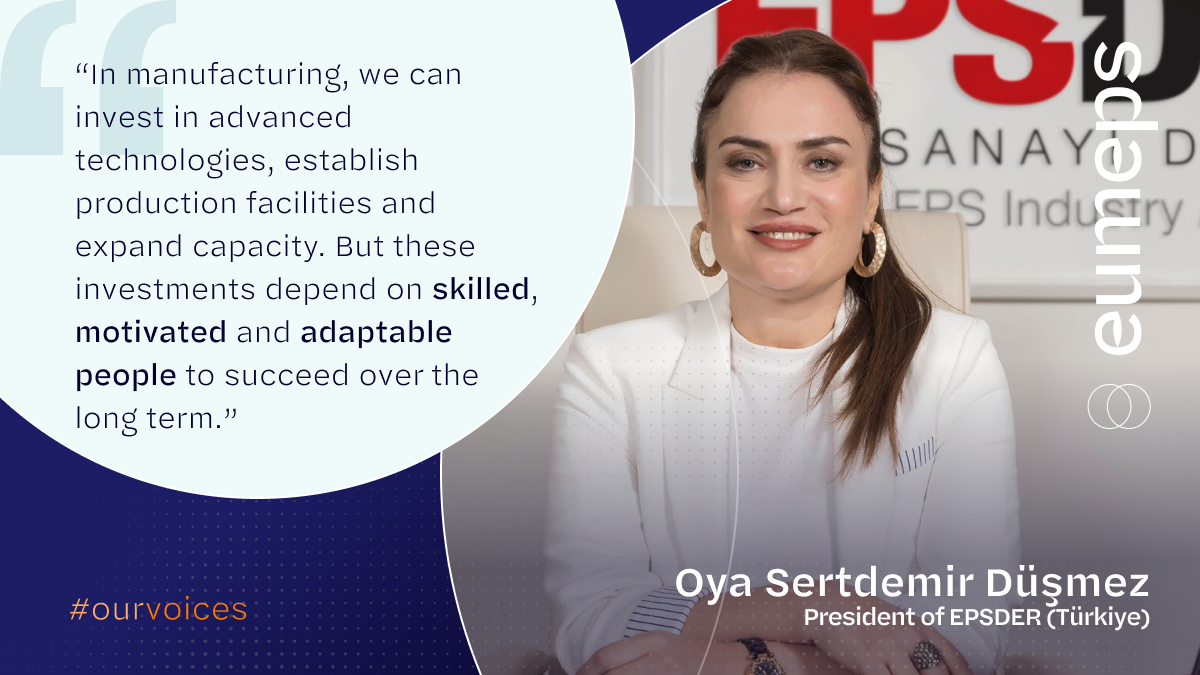
In manufacturing, we can invest in advanced technologies, establish production facilities and expand capacity. But these investments depend on skilled, motivated and adaptable people to succeed over the long term.
This is why I attach considerable importance to continuous learning, professional development, innovation and knowledge sharing within organisations.
Stronger connections between education and industry are also essential. Young people need opportunities to put academic knowledge into practice and understand the realities of modern manufacturing.
As both a woman in industry and an educator, I am particularly committed to encouraging more young women to pursue careers in science, technology, engineering and manufacturing.
For me, successful leadership is measured both by what we achieve today and by the capabilities and opportunities we create for the next generation.
Through EUMEPS, national associations exchange experience across borders. Where would you most welcome closer cooperation?
I consider our relationship with the European EPS industry to be strategically important. There are five areas where I would particularly welcome closer cooperation:
- Energy efficiency and building standards: exchanging experience on thermal insulation requirements, building energy performance and insulation thicknesses.
- Fire safety and technical regulations: discussing assessments of complete construction systems, façade testing methods and regulatory approaches informed by science.
- Circular economy: sharing experience of EPS recycling technologies, collection systems, waste management and circular business models.
- Engineering applications: developing knowledge of geofoam and other applications that demonstrate the versatility of EPS.
- Industry communication: explaining the environmental, technical and economic performance of EPS to policymakers, professionals and the public through evidence.
Türkiye can also contribute experience from its manufacturing sector, diverse climatic conditions and construction market. I see this as a partnership built on mutual learning, with each side bringing useful knowledge.
The international EPS Summit we hope to organise with EUMEPS could provide an opportunity to develop this dialogue. A more coherent industry voice, supported by scientific evidence, would help us address shared challenges across Europe and Türkiye.
What advice would you give to a young person considering a future in industry?
My first piece of advice would be to believe in the value of creating and producing.
Industry offers opportunities in innovation, technology, creativity and sustainability, as well as the chance to make a practical contribution to society.
I would encourage young people to develop strong technical skills, learn foreign languages, remain curious about global developments and build an international outlook.
They should also understand that careers rarely follow a straight path. Challenges, setbacks and uncertainty can provide some of the most valuable learning experiences.
To young women in particular, I would say: never consider industry beyond your reach. The sector needs women’s knowledge, ideas, creativity and leadership. Greater diversity in decision-making can contribute to innovation and competitiveness.
Be courageous, keep learning and do not allow geography or conventional expectations to define the limits of your ambitions. An international career can begin anywhere, including in the heart of Anatolia.
Outside work, what helps you step back and return with a fresh perspective?
Travelling, discovering different cultures and observing how societies develop are important sources of inspiration for me.
I particularly enjoy exploring different approaches to education, urban development, architecture and everyday life. These experiences challenge familiar perspectives and introduce me to new ways of thinking.
Spending time with my family and swimming also help me maintain a balance alongside my professional responsibilities.
I believe effective leadership requires time to step back from daily operations and consider the wider picture. New ideas can emerge while exploring a city, experiencing another culture or simply enjoying a quiet moment of reflection.
Curiosity and lifelong learning remain central to both my personal and professional development.
Building connections across generations and borders
Oya’s reflections reveal a consistent thread across her responsibilities: industrial progress depends on the opportunities people have to learn, contribute and exchange experience. In Elazığ, this means connecting manufacturing with local employment and education. Within EPSDER, it means strengthening technical knowledge and cooperation. Across the EUMEPS network, it means sharing experience between countries.
Her perspective also brings the next generation into the discussion about industry’s future. Investment, research and standards remain central, alongside the work of preparing people to use that knowledge and take on new responsibilities. Through Faces of EUMEPS, these experiences help show the people and relationships behind Europe’s EPS industry.